
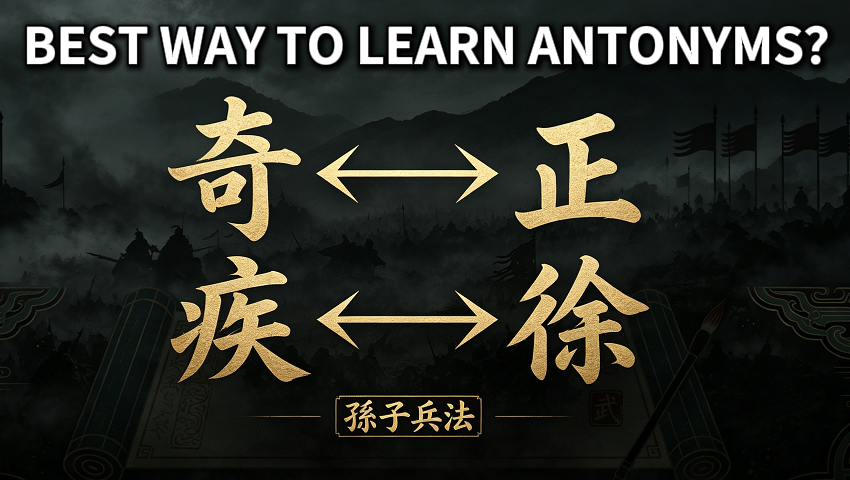
Most people read The Art of War by Sun Tzu as a military book about strategy.
Victory. Defeat. Attack. Defense.
But beneath the surface, there is something most readers never notice:
A hidden system of paired opposites — antonyms that structure meaning itself in Chinese.
This is not about vocabulary lists or grammar rules.
It is a way of thinking built entirely on contrast.
Inside the text, Sun Tzu repeatedly works with paired concepts.
For example:
胜 (shèng) — victory / win
败 (bài) — defeat / lose
But here is the strange part: these are not fixed opposites. They are fluid. They can transform into each other depending on the context.
By looking at The Art of War through this lens, you aren’t just reading a military manual. You are accessing a system of meaning built on opposition.
Through this mindset, you won’t just master Chinese vocabulary; you will begin to understand “Chinese Logic” the way a native speaker does.
So the question is: Why does a strategy text reveal the very structure of the Chinese language?
I. Core Principle — Antonyms in Chinese Are Not Fixed.
In many languages, opposites are stable:
Hot vs. Cold.
Big vs. Small.
But in The Art of War, opposites are:
- Contextual
- Reversible
- Relational
Meaning is never isolated. It always exists in contrast.
Now, let’s go step by step through the layers of this system.
II. Layer One — Action Opposites.
攻 (gōng) vs 守 (shǒu)
- 攻 (gōng) — attack, offensive action
- 守 (shǒu) — defense, protection
At first, they seem like clear opposites. But Sun Tzu never treats them as fixed roles.
A strong 守 (shǒu) can create the opportunity for 攻 (gōng).
A strategic 攻 (gōng) can function as a form of 守 (shǒu).
In this system, 攻 (gōng) and 守 (shǒu) are not opposites — they are interchangeable strategies.
动 (dòng) vs 静 (jìng)
- 动 (dòng) — movement, action
- 静 (jìng) — stillness, waiting
In everyday thinking, movement feels active and stillness feels passive.
But in Sun Tzu’s logic:
Sometimes, 静 (jìng) produces a massive advantage over 动 (dòng).
Waiting is often stronger than acting.
动 (dòng) and 静 (jìng) are not just states — they are tools of timing.
III. Layer Two — Position Opposites
己 (jǐ) vs 彼 (bǐ)
- 己 (jǐ) — self
- 彼 (bǐ) — the other / the enemy
This is not just grammar; it is strategic perception.
Sun Tzu’s most famous logic depends on knowing both sides:
Knowing 己 (jǐ) is not enough.
Knowing 彼 (bǐ) defines the outcome.
But more importantly: 己 (jǐ) and 彼 (bǐ) are not fixed identities. They shift depending on perspective. Self and other are relational, not absolute.
IV. Layer Three — Tempo Opposites
疾 (jí) vs 徐 (xú)
- 疾 (jí) — fast, rapid, urgent
- 徐 (xú) — slow, controlled, gradual
This is not just about speed. It is about the rhythm of strategy.
Sometimes:
疾 (jí) breaks structure quickly.
徐 (xú) creates control through patience.
Speed is not an inherent value; speed is context.
疾 (jí) and 徐 (xú) are timing adjustments, not opposites in value.
V. Layer Four — Strategy Opposites
奇 (qí) vs 正 (zhèng)
- 奇 (qí) — unconventional, unexpected
- 正 (zhèng) — standard, conventional
This is one of the most critical structures in the text. Sun Tzu never separates them.
Instead:
正 (zhèng) builds the foundation and the structure.
奇 (qí) breaks the expectation to create victory.
Neither works alone. 奇 (qí) depends on 正 (zhèng), and 正 (zhèng) depends on 奇 (qí).
In Chinese strategy, choice is not the goal. Balance is.
VI. Layer Five — Outcome Opposites
胜 (shèng) vs 败 (bài)
- 胜 (shèng) — victory
- 败 (bài) — defeat
At first, this seems like the final destination.
But Sun Tzu does not treat it as a fixed endpoint.
Victory is not permanent. Defeat is not final.
A 胜 (shèng) can collapse into ruin.
A 败 (bài) can be transformed into a strategic advantage.
胜 (shèng) and 败 (bài) are not endpoints — they are transitions inside a continuous system.
VII. The Hidden Structure — Meaning Exists Only in Contrast
Now, step back and look at the whole map:
攻 (gōng) / 守 (shǒu)
动 (dòng) / 静 (jìng)
己 (jǐ) / 彼 (bǐ)
疾 (jí) / 徐 (xú)
奇 (qí) / 正 (zhèng)
胜 (shèng) / 败 (bài)
A single structure appears: None of these words exist alone.
Each one only makes sense through its opposite.
But more importantly: None of them are fixed. They are all contextual functions.
VIII. Why This Is Not Just Vocabulary
If you learn these as dictionary pairs, you simply memorize translations.
But through The Art of War, you learn the behavior of meaning.
You learn that:
攻 (gōng) becomes 守 (shǒu).
强 (qiáng – strong) becomes 弱 (ruò – weak).
奇 (qí) becomes 正 (zhèng) depending on the situation.
Antonyms are not just vocabulary. They are transformational relationships inside a system of thought.
IX. Final Insight — Chinese Meaning Is Relational
What makes this text powerful is not just war strategy — it is the structure of thought.
Chinese meaning often emerges through paired tension, not isolated definitions.
A concept is never complete on its own. It only becomes meaningful through its relationship with its opposite.
So the real lesson is simple:
Don’t just memorize antonyms. Observe how they transform each other.
Because in The Art of War — and in the Chinese language — meaning is never singular.
It always exists in relation.
If you enjoyed this, feel free to like, subscribe, and share. I’ll see you in the next journey.