
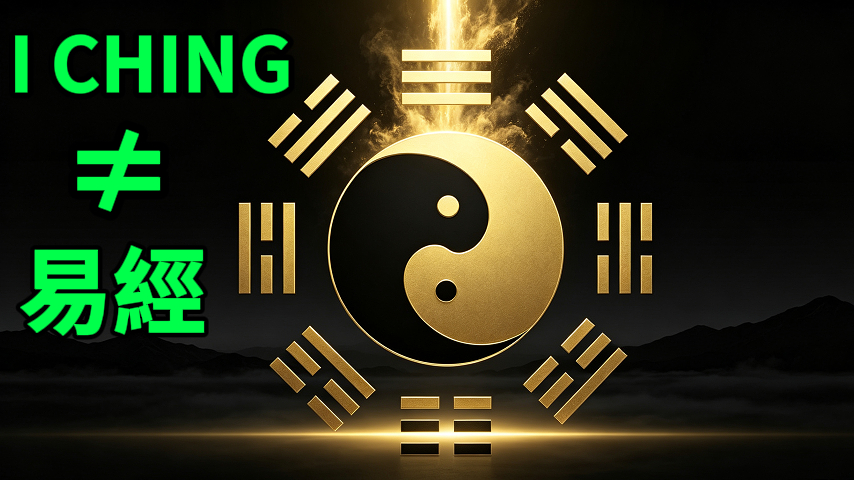
Many people have heard of the IChing. It’s a name that evokes mystery, ancient wisdom, and perhaps a bit of superstition.
But here is the problem: The name “IChing” is a phonetic ghost. It is a transliteration that carries the sound of the words, but completely discards their soul. It’s like having a beautiful, ornate box, but when you translate the name phonetically, you lose the key to opening it.
In Chinese, the title 易经 (Yìjīng) isn’t just a label; it is a curriculum. It is a summary of the entire book’s philosophy. If you don’t understand the two characters that make up its name, you can read the entire text and still be standing outside the door.
Today, we are going to decipher the real meaning of 易经 (Yìjīng). By the end of this journey, you won’t just see a book of divination; you will see a logical framework designed to decipher the mechanics of the world. You will see how the name itself acts as the DNA of the entire book.
I. What is 经 (jīng)?
To understand the book, we must start from the end: the word 经 (jīng).
In modern Chinese, 经 (jīng) is often translated as “Classic.” But why? If we look at the origin of the character, we find the image of a loom. 经 (jīng) originally referred to the longitudinal threads (the warp) on a weaving machine.
Think about that. The vertical threads are the foundation. They are fixed, stable, and they hold the entire fabric together. Because of this, 经 (jīng) evolved to mean a “constant path” or a “fundamental principle.”
When a text is called a 经 (jīng)—like the Dàodéjīng (道德经) or the Shījīng (诗经)—it means this is not a book of opinions. It is a map of the “unchanging tracks” of reality.
So, by calling it 易经 (Yìjīng), we are saying: “These are the fundamental laws of…”—well, that’s where the first character comes in.
II. The Three Faces of 易 (yì)
The character 易 (yì) is the heart of the system. In English, it’s usually translated as “Change”(e.g. Book of Changes). But in the Chinese tradition, 易 (yì) actually contains three distinct, progressive layers of meaning.
Layer One: 变易 (biànyì) — Constant Transformation
The first and most obvious meaning is that everything in the universe is in flux. Nothing stays the same. The seasons shift, life ascends and descends, and relationships breathe in and out.
This is the logic of 阴 (yīn) and 阳 (yáng). In The Art of War, we saw antonyms as strategies; here, we see them as the very engine of the universe. The 易经 (Yìjīng) teaches us how to observe these patterns of change so we are never caught off guard by the turning of the tide.
Layer Two: 不易 (bùyì) — The Immutability
This is the beautiful paradox of Chinese thought. If everything changes, is there anything that doesn’t?
The answer is 不易 (bùyì). While the phenomena of the world are always changing, the laws governing that change are permanent.
- The sun sets, but it always rises in the East.
- Spring ends, but it always returns after Winter.
- When a situation reaches its extreme, it always reverses.
The “Change” itself follows a fixed rhythm. The 易经 (Yìjīng) doesn’t want you to get lost in the chaos of change; it wants you to find the stable “vertical threads” (the 经 jīng) behind the movement.
Layer Three: 简易 (jiǎnyì) — Simplicity
This is perhaps the most misunderstood part. People think the IChing is incredibly complex and difficult. But the third meaning of 易 (yì) is Simplicity.
The philosophy suggests that the most profound truths of the universe are, at their core, simple. Look at the system: It starts with just two lines. A solid line: 阳爻 (yángyáo). A broken line: 阴爻 (yīnyáo).
From these two simple signs, you get the 八卦 (bāguà – Eight Trigrams), and eventually the 六十四卦 (liùshísì guà – 64 Hexagrams). It is a binary code for the universe. The “Great Truth” is expressed with the ultimate simplicity: 大道至简 (dàdào zhì jiǎn).
III. Why “I Ching” Fails
Now, look at what happens when we just say ‘I Ching.’
As a phonetic transliteration, ‘I’ fails to convey the three-layered mystery of 易 (yì), and ‘Ching’ fails to represent the stable, structural weight of 经 (jīng).
When you lose the meaning of these characters, you lose the ‘Instruction Manual’ of the book. You are left with a title that sounds like a name, but functions like a void.
- You lose the sense that it is a constant law (不易 bùyì).
- You lose the sense that it is a simple system (简易 jiǎnyì).
- You are left only with “Change,” which feels like chaos.
But 易经 (Yìjīng) is the opposite of chaos. It is the study of how to find the constant (不易) and the simple (简易) within the movement… within the changes (易).
Conclusion: Relational Wisdom
The real lesson of the 易经 (Yìjīng) is that to understand a text, you must first inhabit its name. Don’t just look at the phonetic sounds; look at the characters. Look for the laws that govern the changes in your life, and look for the simplicity beneath the complexity.
If you like this content, hit ‘like’, subscribe, and share the video. I will see you in the next journey.