
Chinese characters often give you two clues at once. One part suggests the sound. Another suggests the meaning.
This is the basic principle behind 形声字 (xíngshēngzì), or phonosemantic characters, which make up more than 80% of Chinese characters.
But here’s the interesting part:
The semantic clue doesn’t always work the same way.
Sometimes the connection is obvious:
父 (fù, father) →爸 (bà, dad)
But sometimes it seems completely mysterious:
王 (wáng, king) → 理 (lǐ, logic/reason)
So what exactly connects the semantic component to the meaning of the character?
The answer is not one simple rule.
There are actually four different ways this connection works.
And once you recognize them, many characters that look impossible to remember suddenly become much easier to decode.
I. Absolute Identity: When the Component Is the Meaning Itself
Let’s start with the most direct relationship: cases where the semantic component means exactly the same thing, or almost the same thing, as the whole character.
It’s almost as if the component is saying, “I’m still here, just in a different form.”
Take 爸 (bà, dad).
The bottom part, 巴 (bā), provides the sound.
The top is 父 (fù).
And in Classical Chinese, 父 means father.
So the semantic component is essentially the original meaning of the whole character.
It’s a shift from the more formal fù, father, to the everyday bà, dad, but the core meaning remains the same.
The same kind of semantic echo appears in several other characters.
口 (kǒu) and 嘴 (zuǐ): 口 was originally a simple representation of the mouth. Over time, 嘴 (zuǐ) became a more specific everyday word for the physical mouth, while 口 remained as its semantic component. The old concept still gives meaning to the modern word.
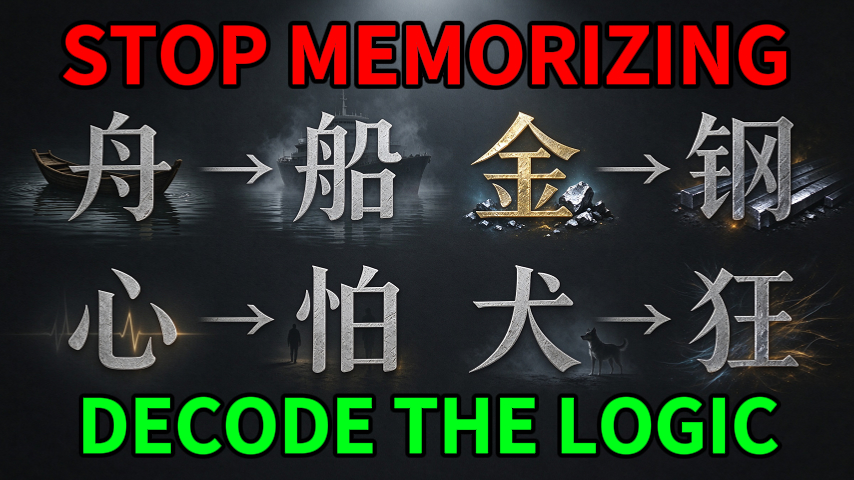
舟 (zhōu) and 船 (chuán): 舟 is the ancient pictograph for a boat or small vessel. Later, 船 (chuán) became the general word for boats and ships, with 舟 as its semantic component. Both point to the same basic reality: something that carries you across water.
目 (mù) and 眼 (yǎn): 目 represents the general concept of the eye and the function of sight. 眼 (yǎn) developed as a more specific word for the physical eye. So 目 signals the visual domain, while the full character identifies the concrete object.
At this level, the semantic component gives you a direct link to the character’s original meaning.
Know the old component, and you already have the core meaning.
II. Categorical Inclusion: A Conceptual Map of the World
The second method is much more productive.
Here, the semantic component is not a synonym. It gives you a general category.
Think of it like a folder on your computer.
The folder tells you the category, while the file tells you the specific item.
Take 钢 (gāng, steel).
On the left is 金 (jīn), the radical associated with metals.
Steel isn’t the same thing as 金, but it belongs to the same broad category.
So 金 gives you the material category, the right side suggests the pronunciation, and the complete character identifies the specific material.
The same system appears throughout the natural world.
木 (mù, tree/wood) →柏 (bǎi, cypress): Seeing 木 immediately tells you that you’re dealing with a tree or something related to wood. The rest of the character narrows it down to a specific tree, the cypress.
鱼 (yú, fish) →鲤 (lǐ, carp): To write “carp,” Chinese combines the phonetic component 里 (lǐ) with the broader biological category 鱼. You may not know the exact fish, but the radical already tells you what kind of thing it is.
气 (qì, gas/air) →氧 (yǎng, oxygen): This shows that the system can adapt to modern concepts. When oxygen was identified, it was classified as a gas, so 气 became its semantic component, combined with a phonetic clue.
水 (shuǐ, water) →河 (hé, river): The three water drops, 氵, signal the domain of water. A river isn’t a drop of water, but it belongs to the world of water. The radical gives the category, while the complete character gives the specific meaning.
Once you understand this pattern, radicals become predictive.
They tell you the broad category before you even know the whole character.
III. Direct Connection: The Logic of Action and State
So far, we’ve been dealing mainly with concrete things: trees, metals, fish, water.
But what happens when we want to express sensations, actions, or mental states?
This is where the third type appears.
Here, the semantic component represents the element, tool, or environment directly involved in the action or state.
Consider these examples.
水 (water) →渴 (kě, thirsty): Thirst is the need for liquid. The radical doesn’t mean “thirst.” It points to the essential element behind the sensation: water.
火 (fire) →烧 (shāo, to burn): Fire is directly involved in the action of burning, so 火 provides the semantic clue.
扌 (hand) →打 (dǎ, to hit): Hitting is a physical action performed with the hand. The radical 扌 tells you what is physically involved in the action.
忄 (heart/mind) →怕 (pà, to be afraid): Fear is abstract, but in the traditional Chinese worldview, emotions were associated with the heart. So 忄 signals an internal or psychological state.
In this third type, the semantic component points to the thing that makes the action or state possible: water behind thirst, fire behind burning, the hand behind hitting, or the heart behind fear.
IV. Indirect Connection: Metaphor, Culture, and Abstraction
Now we reach the most fascinating level.
Sometimes the connection isn’t physical or obvious at all.
Instead, it comes from metaphor, cultural associations, or the historical development of an idea.
This is where characters become windows into how people in the past understood the world.
Take these four examples.
礻 (altar/rituals) →福 (fú, happiness/good fortune): Today, we usually think of happiness as a mental or emotional state. But in ancient China, good fortune was closely connected to ritual and divine blessing. The component 礻 represents an altar and the world of ritual. So the meaning of “good fortune” is indirectly connected to the ancient idea that prosperity and protection came through harmony with ancestors and the spiritual world.
犭 (dog/wild animal) →狂 (kuáng, crazy/frenzied/arrogant): Why would a psychological state like madness or loss of control contain a component associated with animals? Through a behavioral metaphor. Someone acting wildly or without restraint could be compared to a furious or uncontrolled animal. The radical doesn’t identify an animal. It evokes wild behavior.
王/玉 (jade) →理 (lǐ, logic/reason/to manage): The left side of 理 is 王, which here functions as the pictographic form of 玉, jade. So what does jade have to do with reason or logic?
The connection comes from craftsmanship.
To reveal the beauty of raw jade, a craftsman has to follow its natural veins and internal lines with precision. From the physical idea of following the right lines came the more abstract idea of order, reason, and logic.
艹 (grass/plant) →芳 (fāng, virtuous/beautiful/good reputation): In Classical Chinese, 芳 was not simply about a pleasant smell. The pure, lasting fragrance of flowers and herbs became a metaphor for moral virtue, inner beauty, and an honorable reputation. The component no longer describes a physical fact directly. It becomes a bridge from the purity of nature to the purity of the human spirit.
At this fourth level, semantic components become cultural records.
They preserve the ways ancient Chinese thinkers connected the physical world with abstract ideas.
Conclusion
So the semantic component in a phonosemantic character is not just a random hint.
It can repeat the original meaning, define a broader category, point to something directly involved in an action or state, or carry an older metaphor or cultural association.
Once you recognize these patterns, Chinese characters stop looking like isolated symbols.
You start decoding them.
So next time you meet a new character, don’t just memorize it.
Look for the clues.
Because in Chinese, meaning is often something you can decode, not simply memorize.
If you enjoyed this way of looking at Chinese characters, like the video, share it with another learner, and tell me which of the four logic systems surprised you most.
And subscribe for more.