
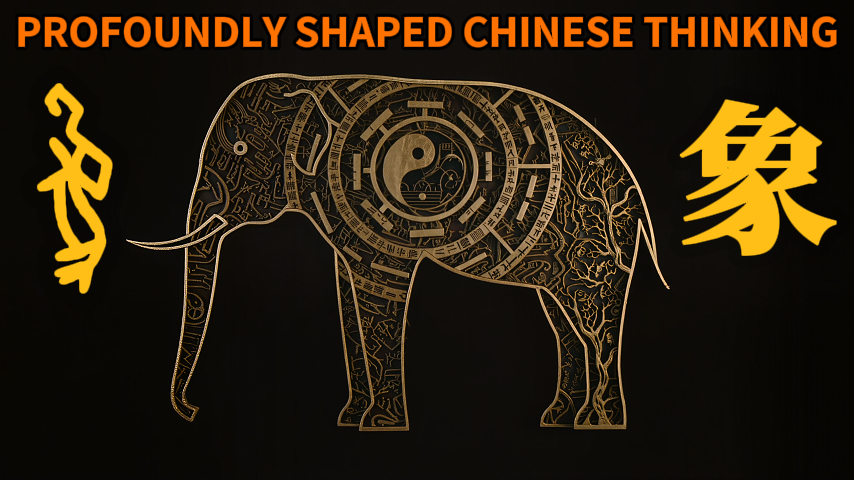
When you hear the word “elephant,” you probably picture an animal: huge, long-trunked, with tusks.
But in Chinese, 象 (xiàng) became much more than that.
It can mean a form, an appearance, a phenomenon, an image, even an imagined representation. It is central to ideas in the I Ching and traditional Chinese medicine.
So how did the character for an elephant become part of an entire way of understanding reality?
Let’s follow that transformation.
I. FROM ELEPHANT TO FORM
More than three thousand years ago, Chinese scribes created 象 by drawing what they saw: an elephant—with its trunk, head, body, legs, and tail.
The earliest Chinese dictionary, the Shuōwén Jiězì, describes it as a large southern animal with a long trunk and tusks, and explains the character as a depiction of its body.
So originally, 象 simply represented a real elephant.
But that raises a question:
If elephants are tropical animals, why did ancient China have a character for them?
Because ancient China was not always as cold and dry as it is today.
The Yellow River basin was once warmer and wetter, and elephants lived there.
At the ruins of Yinxu, archaeologists have found elephant remains, ivory objects, and even records of elephants being used in warfare.
To the people of ancient China, elephants were not exotic animals from a distant world. They were part of their environment.
And this is the key:
象 began with something visible, tangible, and immediately recognizable.
That concrete image would eventually become something much bigger.
From the shape of an elephant…
to the shape of everything.
II. FROM FORM TO IMAGINATION
As people observed elephants, they realized something simple:
To recognize an elephant, we first perceive its overall form.
And the same is true of everything around us.
Everything we encounter appears to us through some kind of visible form or manifestation.
This was the first major expansion of 象:
from the form of an elephant…
to the form of things in general.
We still see this meaning in Chinese today.
景象 (jǐngxiàng) is what we see in a landscape.
天象 (tiānxiàng) refers to celestial phenomena—the sun, moon, and stars.
气象 (qìxiàng) refers to weather and atmospheric changes.
形象 (xíngxiàng) is a person’s appearance or image.
And 现象 (xiànxiàng) is a phenomenon—the way something manifests itself.
So 象 became a way of talking about how the world appears to us.
But then came another important step.
The ancient thinker Han Feizi described a time when people could no longer see living elephants. They only had their bones.
From those bones, they reconstructed the image of a living elephant in their minds.
That imagined reconstruction was also called 象.
And this gives us one of the most important words in Chinese:
想象 (xiǎngxiàng) — to imagine.
Now 象 was no longer only what we see.
It could also be what we construct in the mind.
We can imagine something we’ve never seen, design something that doesn’t yet exist, or picture a future before it happens.
So 象 became a bridge between the external and internal worlds:
between what we perceive…
and what we create in our minds.
And that bridge would become central to Chinese philosophy.
III. FROM IMAGINATION TO A MODEL OF REALITY
Once 象 became a bridge between reality and the mind, it took another step:
it became a tool for understanding reality itself.
This reaches its fullest expression in the I Ching, one of the foundational texts of Chinese thought.
It says:
“是故易者,象也。象也者,像也。”
In other words, the Yi is based on forms, and forms are representations.
Here, 象 is no longer an elephant.
It is a model.
The hexagrams 卦象 (guà xiàng) of the I Ching are combinations of yin and yang lines representing different situations and patterns in reality.
Heaven. Earth. Thunder. Wind…
Each is an 象.
But the symbol itself is not the point.
What matters is what the symbol represents.
The same principle appears again: from something visible, we reconstruct something deeper.
Just as elephant bones allow us to reconstruct an elephant in the mind, symbols allow us to reconstruct the patterns of the world.
That is why 象 also came to mean a sign, indication, or manifestation.
Changes in the sky reveal the rhythms of nature.
Changes in the 象 can reveal the direction in which things are developing.
So 象 becomes a tool not only for understanding the present, but for anticipating change.
This idea goes beyond the I Ching.
Laozi writes in the Dao De Jing:
“执大象,天下往。Zhí dà xiàng, tiānxià wǎng”
“Whoever holds the Great Form, all under Heaven follows.”
The “Great Form” here is not a physical object. It is the deeper structure of reality.
Even in ancient political texts, norms and laws were also understood as “象” (e.g. 象以典刑):
visible models that people could follow.
And this brings us to the core of the whole idea:
a way of understanding reality through its overall form and relationships, rather than breaking everything into isolated parts.
Just as we recognize an elephant as a whole before analyzing every detail, reality can be grasped through its larger pattern.
And it all began with someone drawing an elephant three thousand years ago.
IV. FROM PHILOSOPHY TO EVERYDAY LIFE
The I Ching and Laozi may sound abstract, but this way of thinking never disappeared.
It still appears in everyday Chinese culture.
Traditional Chinese medicine is one of the clearest examples.
Its basic logic is to observe the outside to understand the inside.
By examining the 脉象 (màixiàng, pulse signs), and 病象 (bìngxiàng, signs of illness), practitioners infer what is happening inside the body.
In other words:
from the 象, we reconstruct what cannot be directly seen. ˌThe Chinese writing system follows a similar principle.
The earliest Chinese characters were pictographs, 象形字: drawings that captured the forms of things.
Writing itself began, in a sense, as a form of representation.
Even onomatopoeic words are called 象声词 (xiàngshēngcí)—literally, words that reproduce the form of a sound.
And the idea appears in games as well.
Chinese chess 象棋 (xiàngqí) is not simply a game.
It is a model.
The board represents a battlefield, while the pieces represent elements of a real war.
A complete simulation of reality.
And in everyday language, 象 is everywhere:
万象更新 (wànxiàng gēngxīn, everything is renewed)
气象万千 (qìxiàng wànqiān, a magnificent and changeful spectacle),
险象环生 (xiǎnxiàng huánshēng, signs of danger appearing everywhere)…
We use these expressions without necessarily thinking about their deeper connection.
But they all preserve the same underlying idea:
象 is a way of perceiving, interpreting, and reconstructing reality.
A way of thinking that has survived for thousands of years through language, philosophy, medicine, and culture.
CONCLUSION
So the journey began with a real elephant.
First, 象 represented the animal itself.
Then it came to describe the forms and appearances of things.
From there, it entered the mind as imagination—the ability to construct what we cannot see.
Then, through the I Ching and other classical thought, it became a model for understanding patterns and change.
And eventually, it became part of everyday life—in language, medicine, writing, and culture.
From an elephant…
to a way of seeing the world.
That is what makes Chinese characters so fascinating.
They are not always fixed symbols. Their meanings can expand with the ways people understand reality.
And 象 preserves one powerful idea:
Don’t look at the world as a collection of isolated pieces.
Look at the form.
The relationships.
The whole.
See the 象.
Because in understanding the 象, we are not only understanding the world—
we are also seeing how the human mind makes sense of it.
If you enjoyed this journey into a single Chinese character, subscribe and join me as we uncover more of the cultural and philosophical ideas hidden inside Chinese.
See you in the next one.