
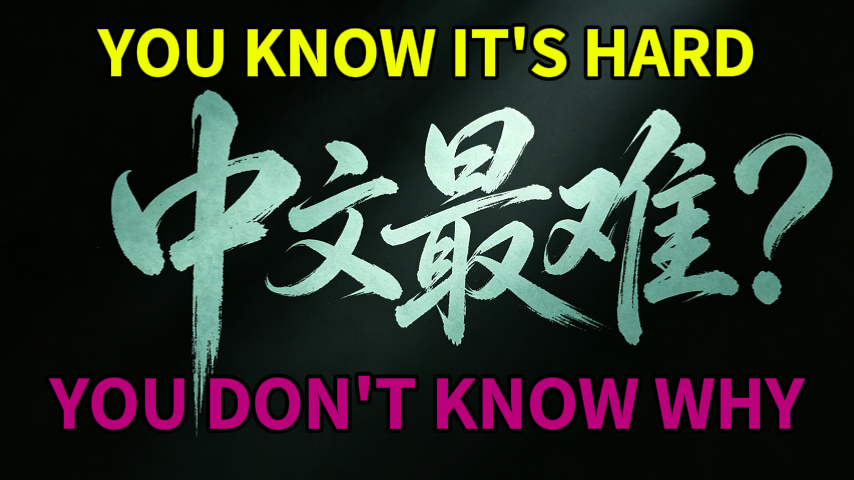
If you’re learning Chinese, thinking about starting, or simply curious about the language, you’ve probably heard this before:
Chinese is the hardest language in the world.
But is it really?
Today, let’s take a closer look, because the answer is not quite what you might expect.
I: Where Does This Idea Come From?
The idea that Chinese is “the hardest language in the world” comes largely from foreign learners.
But people usually judge a language by how different it is from their own.
For a native English speaker, Chinese feels extremely difficult because English and Chinese belong to completely different language families.
English is Indo-European. Chinese is Sino-Tibetan.
They share very little in pronunciation, writing, or grammar.
That’s why an English speaker may find French relatively easy, while a Spanish speaker may find Portuguese even easier. These languages share vocabulary, structures, and historical roots.
Chinese is different. The characters, tones, and ways of expressing ideas can all feel completely unfamiliar.
But now consider a Japanese learner. Japanese already uses many Chinese characters, so reading and writing don’t start from zero.
This tells us something important:
Chinese isn’t absolutely difficult. It’s relatively difficult.
Its difficulty depends on your native language and on the languages you already know.
II: Two “Difficulties” That Are Often Misunderstood
First Point: Chinese Characters
When many foreigners first see Chinese characters, they feel overwhelmed.
“There are so many! They’re all different. How am I supposed to memorize them?”
Some even believe that Chinese has tens of thousands of completely independent symbols that you have to memorize one by one.
But reality is quite different.
The Chinese writing system is not simply a collection of random drawings.
At its foundation are a relatively small number of basic characters, including pictographs and simple ideographic characters. Together, these form the building blocks for a much larger system.
Pictographs originally represented objects visually:
日 (rì), sun
水 (shuǐ), water
手 (shǒu), hand
山 (shān), mountain
人 (rén), person
火 (huǒ), fire
Simple ideographic characters express ideas through abstract marks or modifications:
一 (yī), one
二 (èr), two
三 (sān), three
中 (zhōng), center
上 (shàng), above
下 (xià), below
These are relatively easy to understand.
The important point is that Chinese characters are not thousands of completely unrelated symbols.
Most characters are built from a limited set of recurring components.
So the idea that learning Chinese means memorizing thousands of isolated “drawings” is misleading.
Once you understand the system, the characters become far more logical and accessible than they first appear.
Second Point: Tones
Another commonly exaggerated difficulty is Chinese tones.
Tones don’t simply make Chinese harder. In fact, they allow the language to express different meanings using the same basic syllable.
For example:
芳 (fāng), fragrance
房 (fáng), room
访 (fǎng), visit
放 (fàng), release
The syllable is essentially the same, but the tone changes the meaning.
Without tones, Chinese would need many more completely different syllables to distinguish these words.
There’s another important feature here.
Most Chinese characters are phono-semantic compounds.
For example, 芳, 房, 访, and 放 all contain the phonetic component 方 (fāng), which gives us a clue about pronunciation.
So Chinese characters often combine meaning and sound in a systematic way.
And tones themselves are not unique to Chinese. Many languages around the world, including Thai, Vietnamese, and Burmese, use tones.
Even if your native language doesn’t, you can think of tones as controlled changes in pitch, somewhat like musical notes.
With practice, they can absolutely be mastered.
So what many learners call “difficulty” is often simply difference.
III: So Where Is the Real Difficulty in Chinese?
Is Chinese difficult or not?
As a native speaker, I’d say yes.
But not simply because of the characters or the tones.
The real challenge lies somewhere deeper.
1. The Origin, Evolution, and Extension of Meaning
Chinese characters are not static symbols.
Take 日 (rì). Its original meaning is “sun”, but its meaning extends into an entire network of related concepts:
今日 (jīnrì), today
明日 (míngrì), tomorrow
日班 (rìbān), day shift
日记 (rìjì), diary
生日 (shēngrì), birthday
日子 (rìzi), days or everyday life
Each character has its own semantic network.
Take 气 (qì) as another example.
It can refer to air or rising vapor, but it also appears in:
气体 (qìtǐ), gas
气味 (qìwèi), smell
气象 (qìxiàng), meteorology
气候 (qìhòu), climate
气氛 (qìfēn), atmosphere
气息 (qìxī), breath
气质 (qìzhì), temperament
运气 (yùnqi), luck
There is an invisible chain connecting these meanings.
So learning Chinese isn’t simply memorizing forms.
It’s learning how one underlying concept can extend into different meanings that may seem unrelated at first, but are connected internally.
2. The Relationships Between Characters
Chinese characters don’t exist in isolation.
Look at 木 (mù), tree.
Add a line above it and you get 末 (mò), tip or end.
Add a line below it and you get 本 (běn), root or origin.
Combine 人 (rén), person, with 木 (mù), tree, and you get 休 (xiū), rest, suggesting a person leaning against a tree.
Combine two people and you get 从 (cóng), follow or accompany.
Put 日 (rì), sun, above a line and you get 旦 (dàn), dawn.
Combine 日 (rì) with 干 (gān) and you get 旱 (hàn), drought.
Each character is like a node in a huge network, connected to others through form and meaning.
Once you understand 火 (huǒ), fire, you can recognize:
烧 (shāo), burn
烤 (kǎo), roast
炒 (chǎo), stir-fry
燃 (rán), burn or ignite
And with 水 (shuǐ), water:
江 (jiāng), river
河 (hé), river
湖 (hú), lake
海 (hǎi), sea
洗 (xǐ), wash
澡 (zǎo), bathe
This is the internal logic of Chinese: connection and structure.
It is an interconnected system.
3. The Way Chinese Understands the World
Chinese is deeply metaphorical and often uses concrete images to express abstract ideas.
For example:
伤心 (shāngxīn) literally means “to hurt the heart”, but it means to be sad.
开心 (kāixīn) literally means “to open the heart”, but it means to be happy.
Consider:
看透 (kàntòu), literally “see through”.
It combines the physical action of seeing with the spatial idea of passing through. It means to see through something completely and understand someone’s true nature.
Or:
说穿 (shuōchuān), literally “say through”.
It combines speaking with the physical idea of piercing through. It means to expose the truth or reveal what is really going on.
Behind these expressions is a system of spatial metaphors.
Abstract ideas are treated as if they were physical objects that can be seen, entered, opened, crossed, or pierced.
This is one of the distinctive ways Chinese uses the concrete to express the abstract.
4. The Philosophy and Culture Behind the Characters
As we’ve explored, characters such as:
日 (rì), sun
月 (yuè), moon
水 (shuǐ), water
土 (tǔ), earth
山 (shān), mountain
气 (qì), energy or air
心 (xīn), heart
法 (fǎ), law or method
经络 (jīngluò), meridians
太极 (tàijí), Taiji
阴阳 (yīnyáng), yin and yang
are not merely symbols.
In a sense, each reflects a dialogue between ancient Chinese people and the natural world.
They reveal how people understood existence, the human body, the order of the universe, and the principles behind how things work.
Take 明 (míng), “bright”.
It combines the sun and the moon, the two great natural sources of light.
经络 (jīngluò) uses the language of weaving.
经 (jīng) refers to the longitudinal threads that form the main structure of a textile, while 络 (luò) refers to the threads that branch and interweave. These terms were used to describe the channels of the human body.
太极 (tàijí) combines 太 (tài), something beyond the ordinary or extremely great, with 极 (jí), an extreme or limit. Together, Taiji refers to the fundamental principle from which the universe’s transformations unfold.
And 阴阳 (yīnyáng) originally referred to the shaded and sunny sides of a mountain. Over time, these geographical terms became philosophical concepts representing two opposing yet complementary forces.
To study Chinese deeply is, in many ways, to encounter Chinese philosophy.
So the real challenge of Chinese is not simply memorizing characters or tones.
It is decoding its internal logic:
the connections between characters,
the relationship between form and sound,
the way the language conceptualizes the world,
and the particular way of thinking reflected in the language.
And that is exactly the goal of this channel:
to decode these patterns so you can finally understand the deeper logic of Chinese.
A New Perspective
So, is Chinese really the hardest language in the world?
That depends on how you look at it.
If you see Chinese as thousands of strange symbols and unfamiliar sounds, it can certainly seem overwhelming.
But if you see it as a system of connected parts, concepts, metaphors, and ideas, something changes.
Chinese isn’t simply difficult. It’s deep .
And once you understand its internal logic, what first looked like chaos starts to become a system.
In the end, learning Chinese isn’t just about memorizing a language.
It’s about learning to see how another culture organizes meaning and understands the world.
And perhaps you’ll discover that Chinese was never as impossible as you thought.
Thanks for watching. If you enjoyed this video, like it, share it with someone curious about Chinese, and subscribe for more.
See you in the next video!