
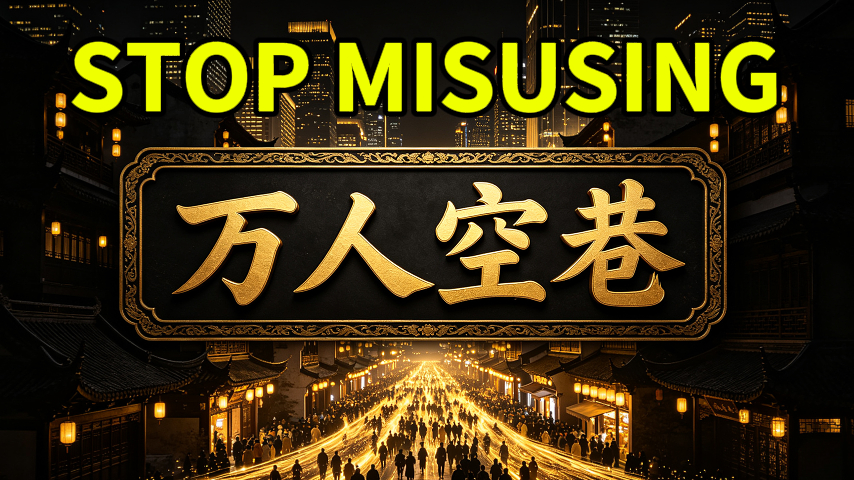
There is one Chinese idiom that many learners completely misunderstand. Even some native speakers occasionally get it wrong when they take it too literally.
Most people interpret it as “empty streets.” But in fact, it means almost the exact opposite.
The idiom is 万人空巷 (wàn rén kōng xiàng).
Literally: ten thousand people, empty alleys.
At first glance, it sounds like a deserted city. But in reality, it describes one of the most crowded and lively scenes imaginable.
Today, we’re going to correct this misunderstanding once and for all — its real meaning, its 900-year-old origin, and most importantly, how to use it correctly.
The Real Meaning
Let’s start with the most important correction.
❌ Wrong meaning: Empty streets, no people, a deserted city.
✅ Correct meaning: Everyone leaves their homes to gather at a major public event, making the residential streets empty as a result.
The “empty alleys” are not the focus — they are just the side effect. The real idea is mass participation in a city-wide celebration.
This is where the confusion comes from: the literal meaning suggests emptiness, but the actual meaning describes overwhelming popularity and public excitement.
A very common mistake goes like this:
❌ 封城期间,整个城市万人空巷。
(Fēngchéng qījiān, zhěnggè chéngshì wàn rén kōng xiàng. During lockdown, the entire city was completely empty / deserted.)
This is incorrect. If people are forced to stay home, this idiom cannot be used. It only applies when people voluntarily leave their homes for a public event.
The Origin
This idiom comes from the Song Dynasty poet Su Shi — also known as Su Dongpo — around the year 1072, during his time in Hangzhou.
At that time, Su Shi served as an official in the city. Every year in August, huge crowds would gather in Hangzhou to watch the Qiantang River tidal bore — one of the most spectacular natural events in the world.
On the 17th day of the eighth lunar month, the tide reaches its peak. Su Shi described this scene in his poetry, and one line later became famous:
“赖有明朝看潮在,万人空巷斗新妆。” (Lài yǒu míng zhāo kàn cháo zài, wàn rén kōng xiàng dòu xīn zhuāng.)
Translation: Luckily we still have tomorrow ’s tide to watch; everyone leaves the streets empty, dressed in their finest clothes.
What this describes is simple: the entire city empties out because everyone is at the river watching the tide together. Not because the city is empty — but because it is completely gathered in one place.
That is how the idiom was born.
And for over 900 years, it has always referred to large-scale public celebration. Never to literal emptiness.
Real Grammatical Usage
Now let’s move to the most important part: how to actually use 万人空巷 in real sentences.
In modern Chinese, 万人空巷appears in three common grammatical patterns.
1. Predicate usage (most common)
It comes directly after the subject (a place e.g., 全城, 这里).
Structure: Place + 万人空巷
Examples:
- 国庆节那天,整个城市万人空巷。
(Guó qìng jié nà tiān, zhěng gè chéng shì wàn rén kōng xiàng.)
On National Day, the entire city turned out for the celebrations. - 这场演唱会当天,全城万人空巷,门票几分钟就卖光了。
(Zhè chǎng yǎn chàng huì dàng tiān, quán chéng wàn rén kōng xiàng, mén piào jǐ fēn zhōng jiù mài guāng le.)
On the day of the concert, the whole city turned out; tickets sold out in minutes. - 世界杯决赛那天,这里万人空巷。
(Shì jiè bēi jué sài nà tiān, zhè lǐ wàn rén kōng xiàng.)
On the day of the World Cup final, everyone here was out watching the game.
2. Attributive usage (modifying a noun)
Here it describes a noun and requires 的 (de).
Structure: 万人空巷 + 的 + noun
Examples:
- 我从未见过这样万人空巷的场面。
(Wǒ cóng wèi jiàn guò zhè yàng wàn rén kōng xiàng de chǎng miàn.)
I have never seen such a massive city-wide celebration. - 这就是当年万人空巷的盛况。
(Zhè jiù shì dāng nián wàn rén kōng xiàng de shèng kuàng.)
This is what the grand celebration looked like back then.
3. Clause usage
It can also be used as a second clause indicating the result of the event.
Structure: Event, 万人空巷
Examples:
- 冠军队伍凯旋归来,万人空巷。
- (Guàn jūn duì wu kǎi xuán guī lái, wàn rén kōng xiàng.)
The champion team returned in triumph, and the whole city came out to celebrate. - 这位巨星到访,万人空巷。
- (Zhè wèi jù xīng dào fǎng, wàn rén kōng xiàng.)
The superstar’s visit drew crowds from across the city.
Key usage rules
- It is only used for positive, large-scale public events — festivals, concerts, parades, victories, or famous visits. Never for negative situations.
- Do not confuse it with:
- 空无一人 (kōng wú yī rén) → completely empty, no people
- 人山人海 (rén shān rén hǎi) → a sea of people
万人空巷 is not emptiness, and not just crowd size — it is collective public movement toward one event.
Summary
To summarize:
- 万人空巷 does NOT mean empty streets
- It means everyone leaves home to attend a major public event
- It comes from Su Shi’s poetry around 1072 describing the Qiantang River tide
- And grammatically, it follows the three patterns we just covered
This is what makes Chinese idioms so powerful — a four-character phrase can compress an entire social scene and emotion into a single expression. But only when it is used correctly.
If this helped you understand it better, feel free to like and subscribe for more content like this.