
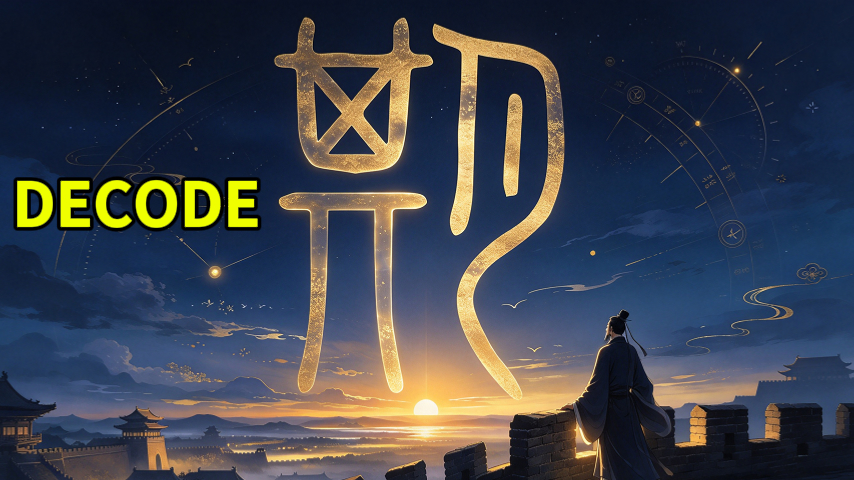
Today, we’re going to decode a Chinese character that appears in some surprisingly different words: 期 — qī.
You see it in:
日期 (rìqī) — date.
期限 (qīxiàn) — time limit.
期待 (qīdài) — to expect, to look forward to.
周期 (zhōuqī) — cycle.
And 第十期 (dì-shí qī) — the tenth issue or installment.
At first, these meanings seem unrelated.
A date is a point in time.
A deadline is a limit.
Expectation is a state of mind.
A cycle repeats.
And 期 can even work as a measure word for numbered installments.
So what connects them?
The answer begins with something much more concrete:
an appointment between people.
From there, 期 develops a remarkably coherent logic — from fixing a moment in the future, to defining periods of time, dividing processes into stages, looking toward what has not yet arrived, and recognizing patterns that return.
Let’s start at the beginning.
I. The Original Meaning: An Appointment to Meet
Let’s begin with the character itself.
Early forms of 期 appear in bronze inscriptions from the Spring and Autumn period.
The character contains 其 (qí) as its phonetic component. In some early forms, the other component is 日 (rì), “day”; in the small-seal form, it became 月 (yuè), “month.”
Both are closely associated with the marking of time.
But the earliest meaning of 期 was not simply “time.”
The Shuowen Jiezi gives a remarkably concise definition:
“期,会也。”
期 means to meet.
Duan Yucai later explained that it carries the sense of making an agreement beforehand, with the purpose of meeting.
So the original idea is quite concrete:
two people agree in advance to meet at a particular time.
This meaning appears clearly in Classical Chinese.
For example:
陈太丘与友期行
Chén Tàiqiū yǔ yǒu qī xíng
Chen Taiqiu arranged with a friend to set out together.
Here, 期 is a verb: to make an appointment, or to arrange something for an agreed time.
The same logic appears in two contrasting expressions:
如期而至
rú qī ér zhì
— to arrive as scheduled, at the appointed time.
And:
不期而遇
bù qī ér yù
— to meet unexpectedly, without having arranged it in advance.
Literally, 不期 means “without an appointment,” while 如期 means “as appointed.” One meeting is unexpected; the other happens exactly when it was expected to.
And in the Book of Songs, we find:
秋以为期
qiū yǐ wéi qī
— let autumn be the appointed time.
The future moment is deliberately fixed.
And that gives us the first key to 期:
It begins with an agreement about when something will happen.
A moment that has not yet arrived is selected in advance and given a role.
That is the original foundation of 期:
a future point in time made definite by an agreement.
II. From an Appointed Time to a Defined Period
Once a future moment has been fixed, it can be identified as a specific point in time.
This is where we get:
日期 (rìqī) — date.
A 日期 is a particular point on the calendar.
And when time is deliberately fixed or arranged at regular intervals, we have:
定期 (dìngqī) — at fixed intervals; regularly; or to set a fixed period.
So the original idea of an appointed time begins to move from a specific meeting toward the broader organization of time.
But 期 can also describe not just a point, but a span.
This is where we encounter:
时期 (shíqī) — a period of time.
And:
期限 (qīxiàn) — a time limit or deadline.
The distinction is simple.
A 时期 is a period.
A 期限 marks the boundary of that period.
And once a boundary exists, other meanings follow naturally:
到期 (dàoqī) — to reach the end of a designated period; to expire.
逾期 (yúqī) — to go beyond that period; to become overdue.
So the logic has expanded:
an appointed moment → a defined period → a boundary in time.
And this idea of a defined period allows 期 to divide something larger into recognizable stages.
Consider the way Chinese describes stages of human life:
婴儿期 (yīng’érqī) — infancy.
青年期 (qīngniánqī) — youth or young adulthood.
中年期 (zhōngniánqī) — middle age.
更年期 (gēngniánqī) — the menopausal transition.
绝经期 (juéjīngqī) — the menopausal period.
老年期 (lǎoniánqī) — old age.
Here, 期 does not mean a specific date.
It marks a recognizable stage within a larger process.
Human life becomes a sequence of periods.
And the same principle can be applied to things that are deliberately divided into successive installments.
For example:
第一期 (dì-yī qī) — the first issue or installment.
第十期刊物 (dì-shí qī kānwù) — the tenth issue of a publication.
一期课程 (yì qī kèchéng) — one course session or term.
Here, 期 functions as a measure word.
Once something is divided into successive periods, each period can be counted:
first, second, tenth, and so on.
So what began as a meeting fixed in the future has expanded into a way of structuring time itself:
a date,
a period,
a deadline,
a life stage,
an installment.
Different words, but the same underlying idea:
期 gives time a defined position or segment.
And once the present is defined in relation to a future point, another possibility appears.
We don’t simply mark that future.
We wait for it.
III. From Future Time to Expectation
Once something is fixed or anticipated in the future, our attention can turn toward it.
This is where 期 takes on a more psychological dimension.
Consider:
期待 (qīdài) — to expect; to look forward to.
期望 (qīwàng) — to hope for; to expect.
期许 (qīxǔ) — to hold hopes or expectations for someone or something.
期冀 (qījì) — to hope for, often in a more literary register.
At this stage, an actual appointment between two people is no longer necessary.
The original structure has become more abstract.
Something lies ahead.
And the present is oriented toward it.
That is the basic logic behind 期待.
We stand in the present and look toward a future that has not yet arrived.
This is beautifully expressed in one of Li Shangyin’s most famous lines:
君问归期未有期
Jūn wèn guīqī wèi yǒu qī
“You ask when I will return, but no return date has been set.”
Here:
归期 (guīqī) means the expected time of return.
And 未有期 (wèi yǒu qī) means that no such time has yet been fixed.
The future exists, but its point in time remains uncertain.
That uncertainty is precisely what turns a fixed time into something anticipated.
So the meaning of 期 has moved once again:
from a time agreed upon,
to a time defined,
and then to a time looked toward.
The external appointment has become an internal expectation.
And this is how 期 enters the language of hope, anticipation, and desire for what is still to come.
IV. From Defined Periods to Recurring Cycles
So far, 期 has described time that we fix, define, divide, or anticipate.
But time does not always need us to set its boundaries.
Some patterns return on their own.
The moon waxes and wanes.
The seasons change.
Plants grow, bloom, wither, and begin again.
This is where we find:
周期 (zhōuqī) — a cycle, a recurring period.
A 周期 is a period that completes itself and returns.
And the same logic appears in:
花期 (huāqī) — the flowering season or flowering period.
A flower has its own time to bloom.
Its 花期 is not a date we simply choose. It is a period associated with the natural rhythm of the plant.
Here, 期 has moved beyond human appointments.
It now marks a recognizable period within a recurring process.
The principle remains the same:
something has its time.
V. 期 and the Limits of Time
At this point, we can see the full range of 期 much more clearly.
It can mark a date:
日期.
A period:
时期.
A limit:
期限.
A stage:
婴儿期, 青年期, 老年期.
A numbered installment:
第一期, 第十期.
A future expectation:
期待.
And a recurring cycle:
周期.
These meanings may look very different on the surface.
But underneath them is one simple structure:
期 gives time a point, a span, or a boundary.
And once time has a boundary, it can be anticipated, reached, completed, and repeated.
Consider three familiar expressions:
期待 (qīdài) — looking toward what has not yet arrived.
如期 (rúqī) — arriving at the expected or appointed time.
到期 (dàoqī) — reaching the end of that designated time.
Together, they almost form a complete movement through time:
we look forward to it,
it arrives,
and eventually, its time comes to an end.
That may be the deepest idea hidden within 期.
It does not simply tell us when something happens.
It gives time a structure:
a point to anticipate,
a period to inhabit,
and a boundary to reach.
Everything that has a 期 exists within time.
And anything that exists within time eventually reaches the end of its 期.
CONCLUSION
From an ancient appointment between two people,
期 grew into dates, periods, deadlines, life stages, installments, expectations, and cycles.
One character.
One underlying logic:
everything has its time.
That is 期.
If you want to keep decoding the hidden logic of Chinese characters, subscribe to Decode Mandarin Chinese.
See you in the next one.