Chinese Homophone

When we buy a pair of shoes, the first thing we want to know is weather it is 耐穿 durable. Some girls are very 耐看 good-looking. You can describe many things with the formula of the prefix 耐. Continue reading “Prefix 耐 and its formula”
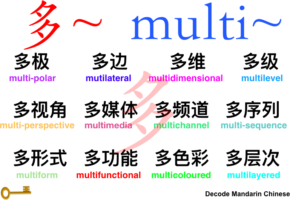
The prefix 多 can be attached in with nouns to form adjectives. Check out its formula and examples. Continue reading “Prefix 多 and its formula”